Project CNCF
All the articles in "Project CNCF".
Checking resource usage with kubectl top, kubectl logs container selection, previous containers, and stdout/stderr, where log files live on the node, and comparing symptoms after breaking Service selectors, targetPort, readiness, CoreDNS, and NetworkPolicy one at a time.
A record of stopping the kubelet and containerd, deliberately breaking the kubelet config and static Pod manifests, then tracking down the cause with kubectl, systemctl, journalctl, crictl, and /var/log/pods on a kubeadm cluster.
The split of roles between GatewayClass, Gateway, and HTTPRoute, host/path/header matching and weighted splitting, allowedRoutes and ReferenceGrant for Routes and backends in other namespaces, and how it differs from Ingress, checked on a kubeadm cluster with NGINX Gateway Fabric and ingress-nginx installed.
The Kubernetes network model, Pod-to-Pod traffic across nodes, how kube-proxy turns Services into iptables rules, NodePort and LoadBalancer, editing the CoreDNS Corefile, and Pod dnsPolicy, checked hands-on on a kubeadm + Calico cluster.
How metrics-server feeds CPU usage to the HPA, kubectl autoscale and the autoscaling/v2 HPA, watching it scale up under load and back down 5 minutes after the load stops, and how it differs from VPA, on a kubeadm cluster.
nodeName, nodeSelector, node affinity, taints and tolerations, Pod anti-affinity, topology spread constraints, and PriorityClass with preemption, placed hands-on on a kubeadm cluster with 2 workers.
Where CRI (between the kubelet and the container runtime), CNI (Pod networking), and CSI (storage) are configured on a node, installing cluster components with Helm and Kustomize, and how an Operator manages components through CRDs, checked on a kubeadm cluster.
Starting from the fact that Kubernetes has no User object: issuing a user certificate with a CertificateSigningRequest and adding it to a kubeconfig, what changes when a ClusterRole is bound with a RoleBinding vs a ClusterRoleBinding, and aggregated and default ClusterRoles, checked on a kubeadm cluster.
Version skew rules, the order for upgrading from 1.34 to 1.35 with kubeadm plus drain/uncordon, etcd backup and restore with etcdctl and etcdutl, and checking and renewing kubeadm certificates, all run hands-on on a VM cluster.
From node prep (swap, sysctl, containerd cgroup driver) to kubeadm init/join, installing a CNI, and a stacked-etcd HA control plane behind kube-vip, all run hands-on on 3 VMs.
How the control plane components (kube-apiserver, etcd, scheduler, controller-manager) and node components (kubelet, kube-proxy, container runtime) connect, plus static Pods and the files under /etc/kubernetes, checked hands-on on a kubeadm cluster.
kubeadm, etcdctl, systemctl, crictl, and kubectl commands plus minimal YAML for each CKA v1.35 curriculum domain, and where to look in the kubernetes.io docs during the exam.
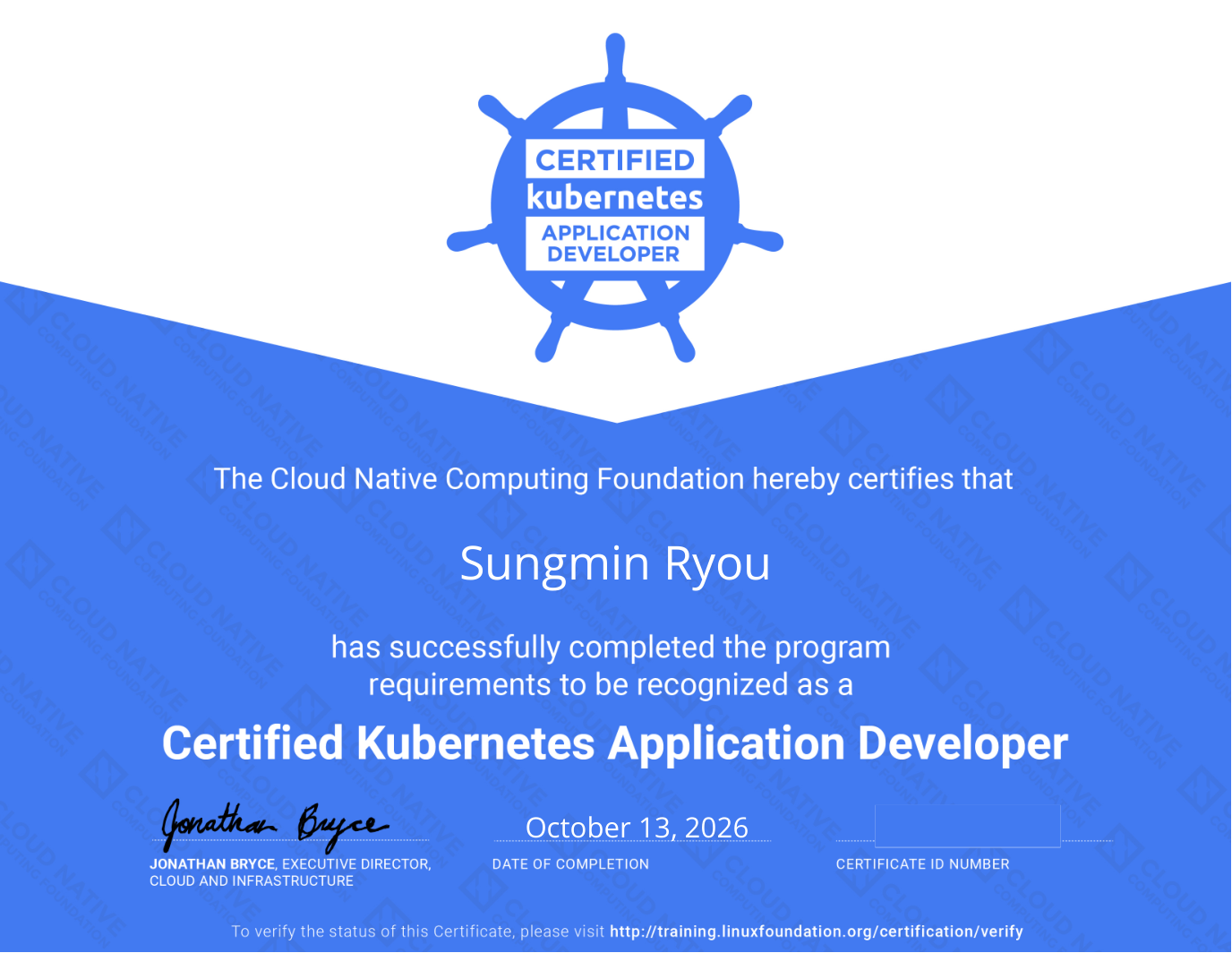
I passed the CKAD exam I took on October 12, 2026, with a score of 80%. Notes on how I prepared, what the exam felt like, and a write-up of the NetworkPolicy question I couldn't solve.
How an exam UI deployed as a static site drives the kind cluster and terminal on each person's own PC.
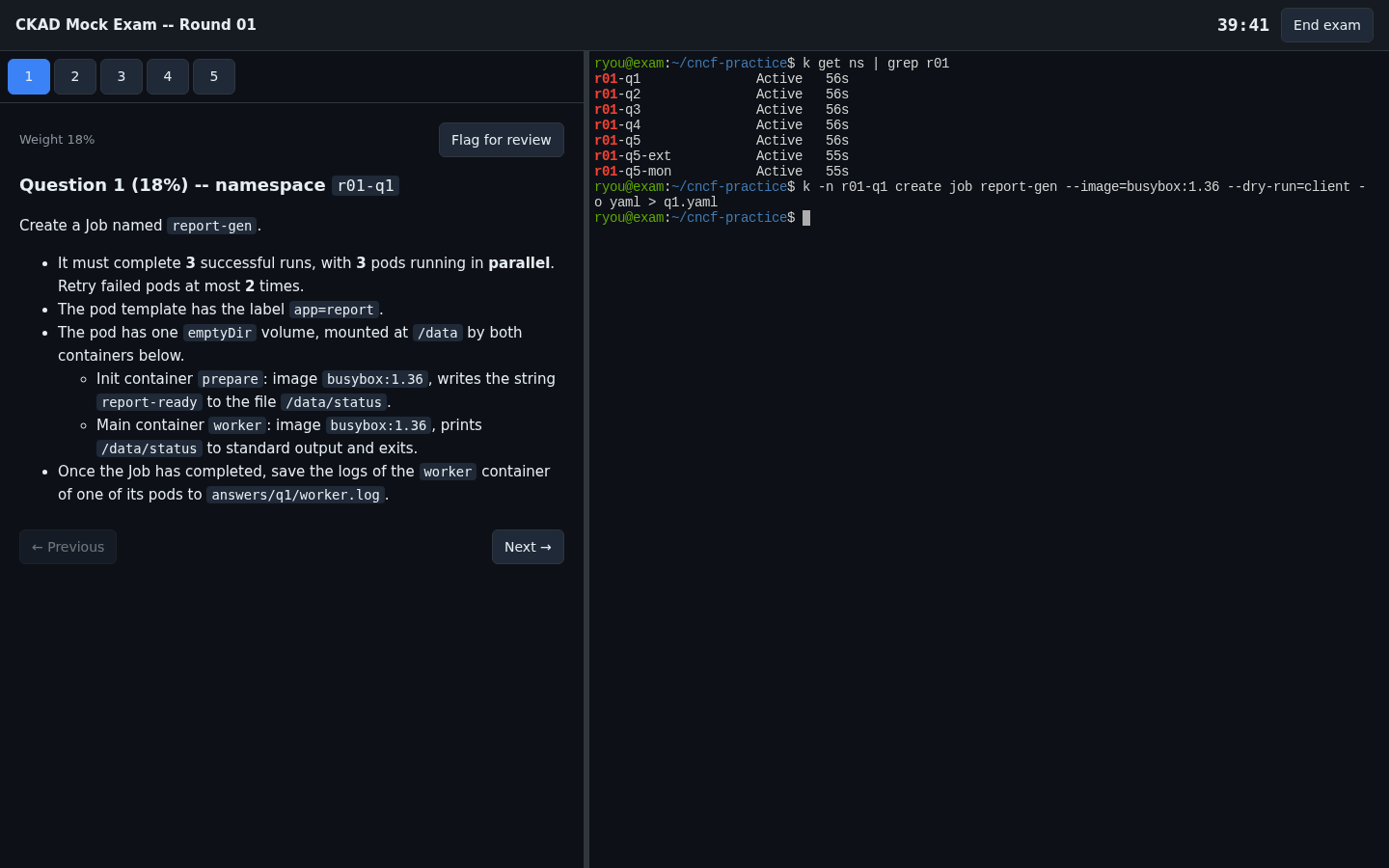
A local CKAD mock exam you can work through in the real exam format, like killer.sh.
Checking state with kubectl get/describe/events/top, reading logs with kubectl logs, and looking inside containers with exec and debug, based on the official docs.
Service types and the path from selector to EndpointSlice, Service DNS names, what to check when a connection fails, Ingress rules and pathType, and NetworkPolicy default deny and selector combinations, based on the official docs.
From why the container filesystem isn't enough to emptyDir, hostPath, configMap volumes, PV/PVC binding, access modes, reclaim policies, StorageClasses, and generic ephemeral volumes, based on the official docs.
Notes on CRDs, custom resources, and Operators that extend the Kubernetes API, and on the rules for deprecating and removing API versions and migrating manifests, based on the official docs.
Notes on how an API request passes through authentication, authorization, and admission, plus ServiceAccounts, RBAC, SecurityContext, and Pod Security Standards, based on the official docs.
Requests drive scheduling, limits are enforced at runtime. CPU throttling vs. OOMKill, QoS classes, LimitRange defaults, and namespace-wide ResourceQuotas, based on the official docs.
How to create ConfigMaps and Secrets, the three ways to get them into a Pod (env, envFrom, volume), how changes propagate, and projected volumes and the Downward API, based on the official docs.
Helm's chart, repository, and release concepts, install/upgrade/rollback/uninstall and values overrides, plus Kustomize's base/overlay, patches, generators, and kubectl apply -k, based on the official docs.
How a Deployment's RollingUpdate and Recreate behave, how maxSurge and maxUnavailable are calculated, the rollout commands, and blue/green and canary deployments built from Service selectors and replica ratios, based on the official docs.
What Deployment, StatefulSet, DaemonSet, Job, and CronJob each guarantee, and when to pick which, compared against the official docs.
Pod phase, conditions, container states, and restartPolicy first, then what actually happens when a liveness, readiness, or startup probe fails, compared against the official docs.
Init containers, native sidecars vs. the classic sidecar approach, the ambassador and adapter patterns, and ephemeral containers, compared against the official docs.
Image names, tags, and digests, the imagePullPolicy default rules, private registries and imagePullSecrets, building and pushing images, and Pod spec basics, based on the official docs.
kubectl commands, minimal YAML, and the kubernetes.io pages to open during the exam, organized by CKAD v1.35 curriculum domain.
I use CNCF technologies practically every day, and I wanted to check how much I can honestly say I actually know them.